CardioTwin-FOUNDATION
Integrated heterogeneous multi-dimensional datasets into a unified, interoperable repository. A scalable pipeline used AI to automatically ingest, preprocess, and harmonize data, with a focus on modularity, validation, and traceability. CARDIOTWIN has adopted standard data models (e.g., HL7 FHIR) for structured, FAIR-compliant data, and integrated regulatory compliance (GDPR) from the outset. This robust infrastructure of high-quality, standardized data is essential for building reliable digital twins.
Explainable AI-Powered Framework
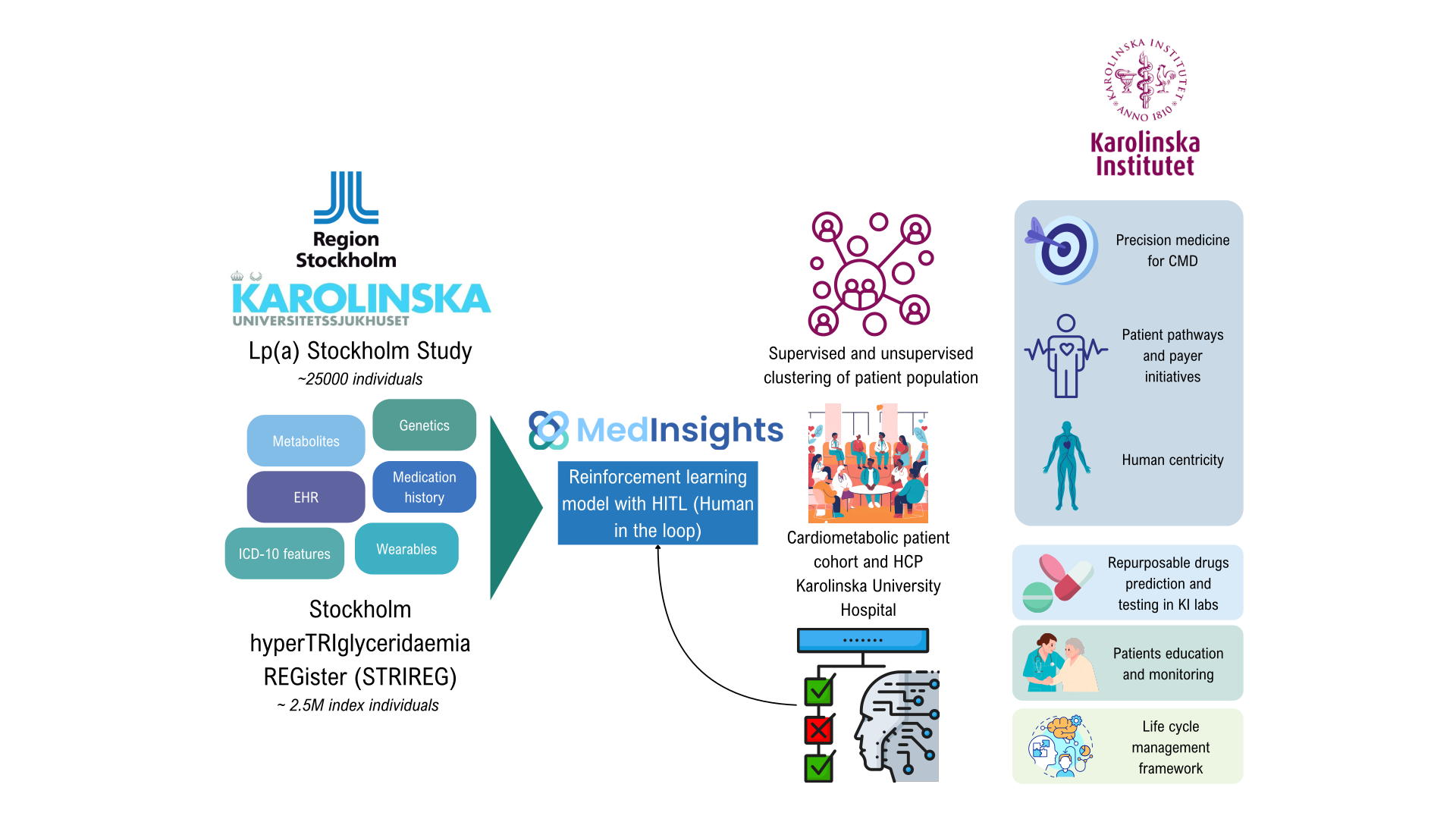
CARDIOTWIN employs Explainable AI models driven NEXUS-Rx framework. This framework would identify relationships between CMD comorbidities and contributing factors, providing a probabilistic understanding of how interventions affect disease and health trajectories. NEXUS-Rx is set to analyze large datasets, including multi-omics, lifestyle datasets and clinical measurements (from sources like the Lp(a) Stockholm study and STRIREG datasets). This analysis aims to discover novel CMD associations, disease pathophysiological features and their central drivers leading to development of clinically meaningful interventions. Network pharmacological approaches in NEXUS-Rx, is posed to become crucial for interpretable predictions, addressing the "black box" problem and improving CMD understanding, risk prediction, and care through insights from real-world data.
Functional Twin Prototype
A functional twin prototype would be designed to provide dynamic, adaptive, and personalized support for cardiometabolic care. This prototype will be built upon a Reinforcement Learning (RL) framework, enabling the system to continuously adapt its recommendations based on individual patient responses, balancing short-term adjustments with long-term health outcomes. The design emphasizes a human-centric approach, treating patients as whole systems and incorporating clinician guidance and patient involvement (Human-in-the-Loop, HITL) in both the development and clinical use of the technology. Key features of the prototype will include interpretable predictions, ensuring that clinicians and patients can understand the system's reasoning; a well-defined regulatory strategy; and a user-friendly experience.
Prototype Scaling & Enhancement
The functional twin prototype would be scaled up and enhanced, moving towards a distributed architecture. This will involve developing a technical architecture suitable for scaling up the prototype and incorporating Federated Learning (FL) capabilities. A distributed functional twin will offer the advantage of enabling multi-institutional secure Reinforcement Learning without requiring the transfer of sensitive patient and healthcare data. The framework will consider various deployment scenarios, such as regional hubs, satellite nodes, and leaf nodes, to achieve this distributed twin architecture. Additionally, metabolic economic modelling functionalities will be added to provide clinically and economically relevant insights on patient-level and disease-dependent costing, offering insights into care efficiencies, inefficiencies, and associated costs.
Pilot deployment and scale up
Functional twin would be developed into clinical practice through an initial pilot deployment in the Swedish healthcare system, leveraging its strong digital infrastructure, progressive approach, and robust data governance. A scalability roadmap would be developed to transition from this pilot deployment to multi-site adoption across healthcare networks, both within and outside Sweden. Finally, a sustainability strategy and functional twin lifecycle plan would be established to ensure the project's outcomes are sustained beyond its initial funding period.
Content Information : Manish Sarkar, business development, manish.sarkar@medinsights.fr