
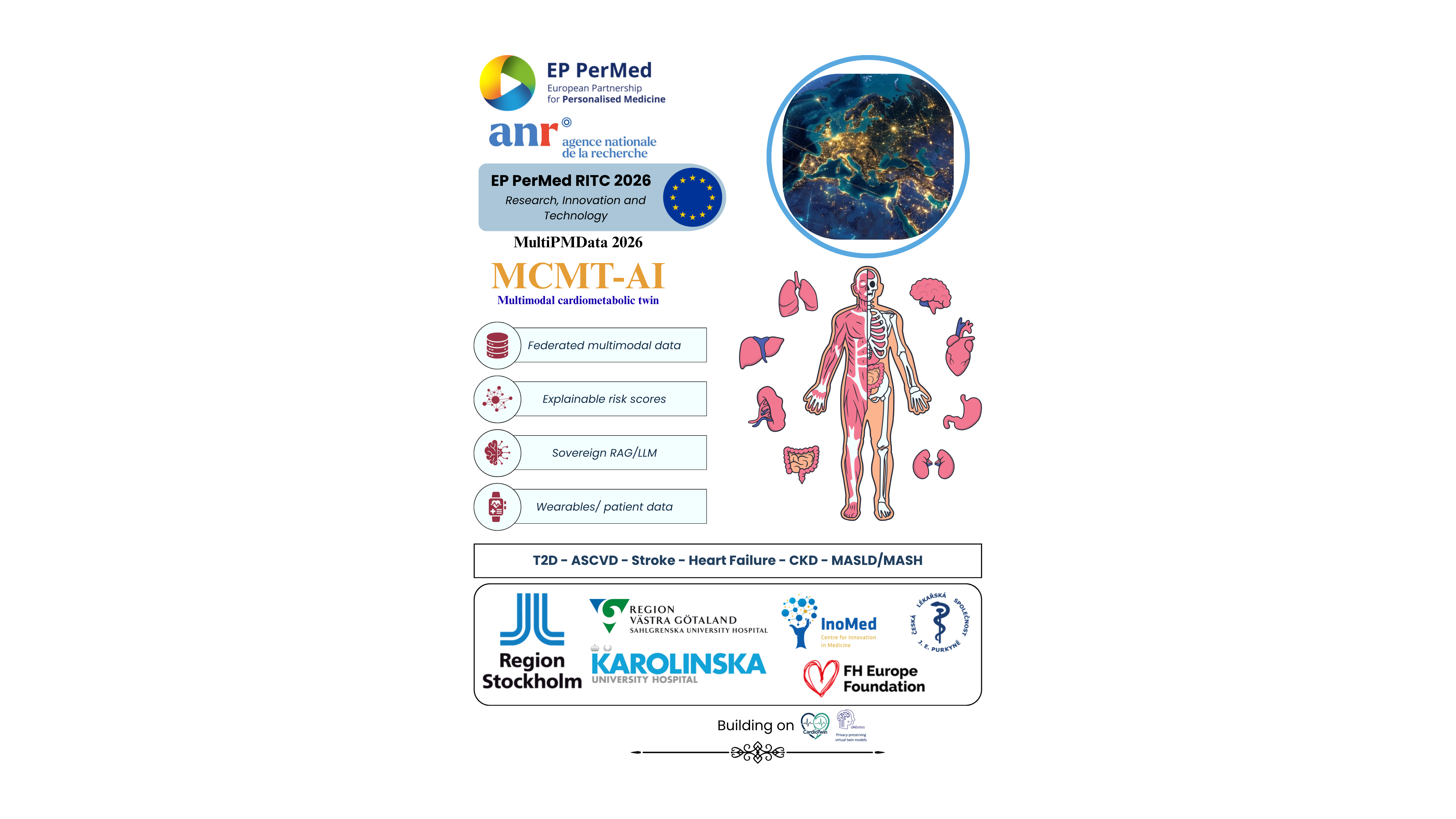
PARIS & STOCKHOLM - The MCMT-AI (Multimodal CardioMetabolic Twin) project has officially been awarded funding by EP PerMed (the European Partnership for Personalised Medicine) and national funding agencies including the French National Research Agency (ANR) under the RITC 2026 call "Test and Demonstration of Multimodal Data Approaches for Personalised Medicine" (MultiPMData2026). The strategic grant writing and proposal development were led by consultancy firm Evolution Europe.
The project is expected to address a total market of $23.1B to $37.3B across AI drug discovery, clinical analytics and digital twins, with a projected growth of 24.5% per year. The serviceable market includes a serviceable market of $4.1B to $6.5B in line with the top 250 biopharma R&D budgets and Tier-1 hospitals. The virtual twin is expected to leverage responsible AI to improve the rapidly thinning pharmaceutical pipelines, thanks to deep intelligence such as patient stratification, risk assessments, trends on medications and drug repositioning.
The project is led by Prof. Paolo Parini. Prof. Parini is Professor of Clinical Chemistry at Karolinska Institutet, Director of Research, Education, Development & Innovation, and Senior Consultant in Endocrinology at Karolinska University Hospital’s Theme Inflammation and Ageing. He leads as Coordinator of the Cardio Metabolic Unit (CMU) - a translational research constellation bridging the Department of Medicine, Huddinge, and the Department of Laboratory Medicine at Campus Flemingsberg to integrate cutting-edge cardiometabolic research directly into specialized clinical care. A recognized authority across the full translational spectrum, Prof. Parini’s work spans molecular lipid biology, clinical implementation, and cardiovascular drug discovery. Demonstrating this translational impact, he is co-inventor and co-owner of a patented, novel class of orally active PCSK9 inhibitors currently advancing through Phase I clinical trials.
“Our goal is to show feasibility, actionability, implementation readiness and early signals of value for the health system, and to turn those results into HTA and scale-up scenarios. A big thank you to all partners and colleagues who made this possible, and to EP PerMed and the national funders for their support. We look forward to getting started!” said Prof. Parini.
Moving Beyond Single-Disease Silos
Cardiometabolic conditions such as type 2 diabetes (T2D), atherosclerotic cardiovascular disease (ASCVD), stroke, heart failure, chronic kidney disease (CKD), and MASLD/MASH, rarely occur in isolation. Despite their frequent co-occurrence, today’s standard clinical risk evaluation tools (including SCORE2, KFRE, and FIB-4) remain constrained to single-disease assessments. This traditional approach leaves vast volumes of rich, multimodal patient data underutilized in daily clinical decision-making. MCMT-AI bridges this critical gap by delivering an explainable, federated digital twin specifically designed for integrated cardiometabolic multimorbidity management.
Next-Generation AI Built on European Data Sovereignty
Building upon foundational progress from the CardioTwin and dAIbetes initiatives, MCMT-AI combines Graph Neural Networks (GNNs), deep learning, bounded "what-if" simulation models, and an interpretable, EU-sovereign Retrieval-Augmented Generation (RAG) and a conversational Large Language Model (LLM) layer.
A defining feature of the project is its strict adherence to privacy and local data governance:
- Federated nature of operations: Patient data remains securely at its origin node with zero central patient-level data repositories.
- Rigorous data quality and provenance: Data provenance, missingness handling, subgroup performance, and calibration are evaluated as core project deliverables before live clinical deployment.
Testing Across Three Key Clinical Decision Points
The MCMT-AI digital twin will be validated in real-world clinical workflows against usual care and single-disease comparators across three vital intervention points:
- Integrated risk characterization: Continuous monitoring of near-term disease progression across overlapping metabolic and cardiovascular risks.
- Treatment review and therapy management: Evaluation to guide safer, optimized multi-therapy regimens.
- Remote and early deterioration monitoring: Integration of wearable devices and patient-reported outcomes to detect signs of clinical decline before acute events occur.
"Cardiometabolic diseases are deeply interconnected, yet our clinical toolbox remains fragmented. With MCMT-AI, we are advancing from reactive, single-disease treatment to proactive, holistic care powered by sovereign, explainable AI. Our focus is to demonstrate concrete clinical utility, implementation readiness, and health economic value to pave the way for HTA assessment and European scale-up." - MCMT-AI Project Consortium
International Multidisciplinary Partnership
The project unites leading European medical centers, patient advocacy organizations, and technical innovators:
- Clinical data nodes: Region Stockholm / Karolinska University Hospital (Sweden), Västra Götalandsregionen / Sahlgrenska University Hospital (Sweden), and Všeobecná fakultní nemocnice v Praze / General University Hospital in Prague (Czech Republic).
- Citizen and implementation lead: Centre for Innovation in Medicine / INOMED (Romania), leading citizen and patient involvement in a dedicated Living Lab environment.
- Technical and commercial lead: MedInsights (France), driving actionable health innovation and responsible cybernetics.
- Patient Advocacy partner: FH Europe Foundation (Netherlands).
Key leadership driving the project forward includes Prof. Paolo Parini, Dr. Marius Geanta, Magdalena Daccord, Dr. Peter Kelly, Dr. Michal Vrablík, Dr. Matteo Pedrelli, Dr. Darren Noronha, and Dr. Soham Saha.
About MCMT-AI
MCMT-AI (Multimodal CardioMetabolic Twin: AI-driven multimodal digital twin for personalised management of cardiometabolic multimorbidity) is a European research project funded by EP PerMed under the MultiPMData2026 call. The project aims to validate federated AI digital twin technologies in real-world clinical settings to improve multi-disease risk prediction, therapy safety, and long-term outcomes for patients with cardiometabolic multimorbidity.
Back to all news